
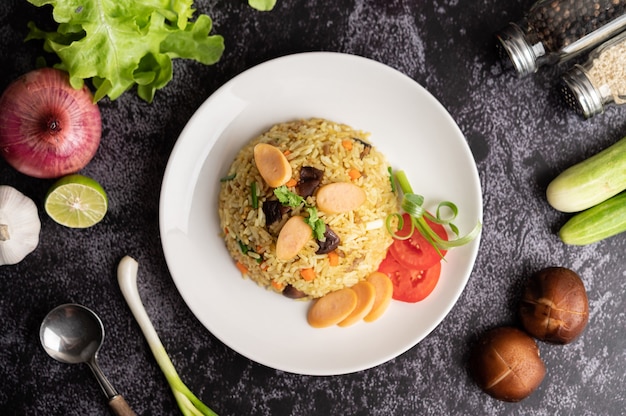
- Country of origin
- 🇹🇭 Thailand
- Category
- Main Course
- Difficulty
- ●○○ Easy
- Preparation
- 15 min
- Cooking
- 10 min
- Servings
- 4 people
History
Khao pad, Thai fried rice, illustrates the ancient Chinese influence on Thai cuisine: the technique of wok-frying rice is believed to have been introduced through waves of Chinese immigration, then adapted to local ingredients and condiments like fish sauce, chili, and lime.
An inexpensive everyday dish served equally in street stalls and restaurants, khao pad is traditionally made with day-old rice, slightly dried out, which separates into individual grains better when cooked than freshly made rice — not thrift dressed up as tradition, but a genuine textural requirement, and the single most common reason home versions fail.
Ingredients — serves 4
- 1.1 lb (500g) cooked, cooled rice (ideally day-old)
- 7 oz (200g) chicken or shrimp
- 2 eggs
- 1 onion, 2 garlic cloves
- Soy sauce, fish sauce, sugar
- Lime, cilantro, scallions
Khao Pad, step by step
- Heat oil in a very hot wok and sauté the minced garlic and onion.
- Add the chicken or shrimp and cook for a few minutes until golden.
- Push the ingredients to the side, crack the eggs into the wok, and scramble them quickly.
- Fold in the cold rice, breaking it up with a spatula to separate the grains well.
- Season with soy sauce, fish sauce, and a pinch of sugar, tossing vigorously over high heat.
- Sprinkle with scallions and cilantro, and serve with a lime wedge and chili on the side.
Cooking method
Technique: a fast wok-fry at very high heat (“wok hei”), which reheats the rice without making it mushy while developing a lightly smoky aroma.
Traditional equipment: a steel wok set over a powerful gas burner.
Signs it’s ready: the rice should stay well separated, grain by grain, lightly golden in spots, without becoming sticky.
Nutrition, per serving
The sodium figure is the one to look at. At roughly 720 mg per serving, a single plate carries around 36% of the 2,000 mg daily limit the WHO recommends for adults — and almost none of it comes from the salt cellar. It comes from the soy sauce and the fish sauce, which are salt solutions by design: fish sauce runs to roughly 1,400 mg of sodium per tablespoon on its own.
This is useful to know because it is controllable. Cutting the fish sauce by half and compensating with lime juice and white pepper — a common adjustment in home kitchens — takes several hundred milligrams off the plate without flattening the dish, since much of what reads as “seasoned” is acid and aroma rather than salt.
Made with shrimp instead of chicken, protein stays close to 23 g while fat drops by roughly 4 g per serving.
Economic context
Khao pad’s whole reason for existing is economic: it is the cheapest way to turn leftover rice into a complete meal, built from staples — rice, egg, a little protein — rather than anything imported or seasonal. That is why it is street food rather than restaurant cooking, and why every stall in Thailand makes its own version.
Source: World Bank / FAO, Food Prices for Nutrition database (Cost and Affordability of a Healthy Diet) v4.0, 2024 data, CC BY 4.0, DOI 10.57966/41AN-KY81. Retrieved 29 July 2026. This figure describes the cost of a healthy diet in Thailand generally — it is not a costing of this specific recipe.
Who this dish suits
Fits well with
- Quick weeknight cooking — 15 minutes, one pan
- Using up leftovers; day-old rice is required, not tolerated
- Moderate calorie meals at 375 kcal a serving
- Very low cost per head
Worth knowing
- High sodium at ~720 mg per serving, from the sauces
- Contains fish sauce and egg — relevant for allergen checks
- Standard soy sauce contains gluten unless tamari is used
- Needs a genuinely hot pan; a crowded wok steams the rice
What about you?
In your opinion, where’s the best place or restaurant to try great khao pad?